
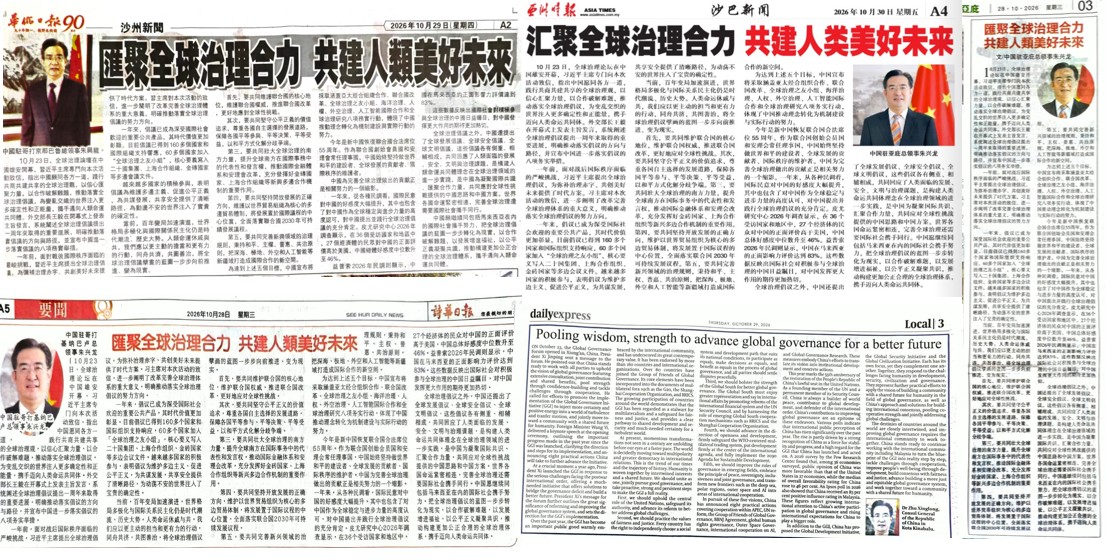
On October 28, the Consul General Zhu Xinglong, published a signed article titled “Pooling Wisdom and Strength to Advance Global Governance to Build a Better Future for Humanity” in several mainstream Chinese, English media outlets in Sabah, including Asia Times, See Hua Daily News, Sin Chew Daily, Overseas Chinese Daily News, Daily Express. The full text is as follows:
On October 23, the Global Governance Forum opened in Xiong’an, China. President Xi Jinping sent a message to the forum. He pointed out that China stands ready to work with all parties to uphold the vision of global governance featuring extensive consultation, joint contribution and shared benefits, pool strength through confidence-building and tackle challenges through cooperation. He called for efforts to promote the implementation of the Global Governance Initiative (GGI) to inject more certainty and positive energy into a world of turbulence and tranfer motion , and jointly move toward a community with a shared future for humanity. Foreign Minister Wang Yi, delivered a keynote speech at the opening ceremony, outlining the important progress made in the past year since the GGI was launched, clarifying the direction and steps for its implementation, and announcing eight practical actions China will take to further advance the Initiative.
At a crucial moment a year ago, President Xi launched the GGI in response to the serious challenges facing the postwar international order, offering a much-needed initiative that offers solutions to bridge the governance deficit and build a better future. President Xi’s message for the forum further outlines the great significance of reforming and improving the global governance system, and sets the direction for the GGI’s implementation.
Over the past year, the GGI has become an important public good warmly embraced by the international community, and has underscored its great contemporary value. It has been endorsed by more than 160 countries and international organizations. Over 60 countries have joined the Group of Friends of Global Governance. Its core elements have been incorporated into the documents of multilateral fora such as the G20, the Shanghai Cooperation Organization, and BRICS. The growing participation of countries around the world demonstrates that the GGI has been regarded as a stalwart for multilateralism and a safeguard for fairness and justice, and provides a clear pathway to shared development and security and much-needed certainty for a turbulent world.
At present, momentous transformations not seen in a century are unfolding before our eyes at a faster pace. The world is decidedly moving toward multipolarity and greater democracy in international relations. This is the trend of our times and the trajectory of history. Humanity is woven together by intertwined interests and a shared future. We should unite as one, jointly pursue good governance, and take proactive, strong and persistent steps to make the GGI a full reality.
First, we should uphold the central role of the United Nations, safeguard its authority, and advance its reform to better address global challenges.
Second, we should practice the values of fairness and justice. Every country has the right to independently choose a social system and development path that suits its national conditions, to participate as equals, make decisions as equals, and benefit as equals in the process of global governance, and all parties should settle disputes peacefully.
Third, we should bolster the strength of the Global South for better global governance. The Global South must enjoy greater representation and say in international affairs by promoting reforms of the international financial system and the UN Security Council, and by harnessing the role of emerging Global South cooperation mechanisms such as BRICS and the Shanghai Cooperation Organization.
Fourth, we should advance in the direction of openness and development, firmly safeguard the WTO-centered multilateral trading system, put development firmly at the center of the international agenda, and fully implement the 2030 Agenda for Sustainable Development.
Fifth, we should improve the rules of governance in emerging fields, embrace the principle of peace, sovereignty, inclusiveness and joint governance, and transform new frontiers such as the deep sea, polar regions, outer space and AI into areas of international cooperation.
In pursuit of these five visions, China has announced eight practical actions covering cooperation within APEC, UN reform, the Group of Friends of Global Governance, BBNJ Agreement, global human rights governance, Outer Space Governance, international cooperation on AI, and Global Governance Research. These measures embody China’s efforts to translate its vision into institutional development and concrete actions.
This year marks the 55th anniversary of the restoration of the People’s Republic of China’s lawful seat in the United Nations. As a founding member of the UN and a permanent member of its Security Council, China is always a builder of world peace, contributor to global development, and defender of the international order. China’s contributions to improving global governance are an epitome of these endeavors. Various polls indicate that international public perception of China has risen significantly over the past year. The rise is partly driven by a strong recognition of China as a force for stability and progress, and a high regard for the GGI that China has launched and acted on. A 2026 survey by the Pew Research Center found that, among 36 economies surveyed, public opinion of China was more favorable than that of the United States in 27 economies, while the median of overall favorability rating for China rose to 46%. An Ipsos poll in 2026 also showed that China received an 83% positive influence rating in Malaysia. These figures reflect growing international attention to China’s active participation in global governance and rising international expectations for China to play a bigger role.
In addition to the GGI, China has proposed the Global Development Initiative, the Global Security Initiative and the Global Civilization Initiative. Each has its own focus, yet they complement one another. Together, they respond to the challenges facing humanity in development, security, civilization and governance. They represent further practical efforts to apply the vision of building a community with a shared future for humanity in the field of global governance, as well as China’s approach and solutions for building international consensus, pooling cooperative strength and jointly addressing global challenges.
The destinies of countries around the world are closely intertwined, and improving global governance requires the international community to work together. China stands ready to continue working with the international community including Malaysia to turn the blueprint of the GGI into reality step by step, tackle challenges through cooperation, improve people’s well-being through development, build consensus with fairness and justice, advance building a more just and equitable global governance system, and work together toward a community with a shared future for humanity.