
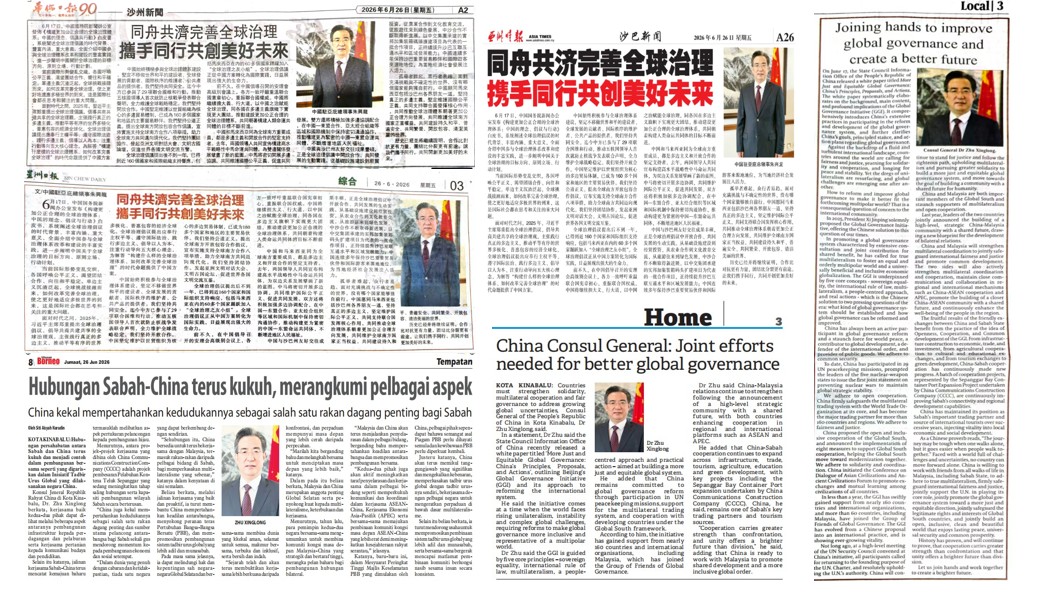
On June 26, the Consul General Zhu Xinglong, published a signed article titled "Joining Hands to Improve Global Governance and Create a Better Future" in several mainstream Chinese, English and Malay media outlets in Malaysia and Sabah, including Asia Times, See Hua Daily News, Sin Chew Daily, Overseas Chinese Daily News, Daily Express, The Borneo Post and Utusan Borneo. The full text is as follows:
On June 17, the State Council Information Office of the People’s Republic of China released a white paper titled More Just and Equitable Global Governance: China's Principles, Proposals, and Actions. The white paper systematically elaborates on the background, main content, and profound implications of the Global Governance Initiative (GGI). It comprehensively introduces China's extensive practices in participating in the reform and development of the global governance system, and further clarifies China's goals, principled stance, and action plans regarding global governance.
Against the backdrop of a fluid and turbulent international landscape, countries around the world are calling for fairness and justice, yearning for solidarity and cooperation, and longing for peace and stability. Yet the dregs of unilateralism are resurfacing, and global challenges are emerging one after another. How to reform and improve global governance to make it better fit the forthcoming multipolar world? That is a consequential question of concern to the international community.
In 2025, President Xi Jinping solemnly proposed the Global Governance Initiative, offering the Chinese solution to this question of our times. In promoting a global governance system characterized by extensive consultation and joint contribution for shared benefit, he has called for true multilateralism to foster an equal and orderly multipolar world and a universally beneficial and inclusive economic globalization. The GGI is underpinned by five core concepts - sovereign equality, the international rule of law, multilateralism, a people-centered approach, and real actions - which is the Chinese solution to two pressing questions of the era: what kind of global governance system should be established and how global governance can be reformed and improved.
China has always been an active participant in global governance reform and a staunch force for world peace, a contributor to global development, a defender of the international order, and provider of public goods. We adhere to common security. To date, China has participated in 29 UN peacekeeping missions, prompted the leaders of the five nuclear-weapon states to issue the first joint statement on preventing nuclear wars to maintain global strategic stability. We adhere to open cooperation. China firmly safeguards the multilateral trading system with the World Trade Organization at its core, and has become the major trading partner for more than 160 countries and regions. We adhere to fairness and justice. China proposed the open and inclusive cooperation of the Global South, and announced the implementation of eight measures to support Global South cooperation, helping the Global South move toward modernization together. We adhere to solidarity and coordination. China initiated the Conference on Dialogue of Asian Civilizations and Ancient Civilizations Forum to promote exchanges and mutual learning among civilizations of all countries.
In less than a year, the GGI has swiftly gained support from nearly 160 countries and international organizations, and more than 60 countries, including Malaysia, have joined the Group of Friends of Global Governance. The GGI has evolved from a Chinese proposal into an international practice, and is showing ever-growing vitality.
Not long ago, at a high-level meeting of the UN Security Council convened at China's initiative, all participants called for returning to the founding purpose of the U.N. Charter, and resolutely upholding the U.N.’s authority. China will continue to stand for justice and follow the righteous path, upholding multilateralism and pursuing greater solidarity to build a more just and equitable global governance system, and move towards the goal of building a community with a shared future for humanity.
China and Malaysia are both important members of the Global South and staunch supporters of multilateralism and open cooperation. Last year, leaders of the two countries jointly announced the building of a high-level, strategic China-Malaysia community with a shared future, drawing a new blueprint for the development of bilateral relations. China and Malaysia will strengthen multilateral coordination to jointly safeguard international fairness and justice and promote common development. The two sides will also actively strengthen multilateral coordination and cooperation, maintain close communication and collaboration in regional and international mechanisms such as China-ASEAN cooperation and APEC, promote the building of a closer China-ASEAN community with a shared future, and continuously enhance the well-being of the people in the region.
The fruitful results of the friendly exchanges between China and Sabah State benefit from the practice of the idea of Openness, Cooperation, and Common development of the GGI. From infrastructure construction to economic, trade, and investment, from agricultural cooperation to cultural and educational exchanges, and from tourism exchanges to green development, China-Sabah cooperation has continuously made new progress. A batch of cooperation projects, represented by the Sepanggar Bay Container Port Expansion Project undertaken by China Communications Construction Company (CCCC), are continuously improving Sabah's connectivity and regional development capabilities. China has maintained its position as Sabah's important trading partner and source of international tourists over successive years, injecting vitality into local economic and social development.
As a Chinese proverb reads, “The journey may be tough when one walks alone, but it goes easier when people walk together.” Faced with a world full of challenges and uncertainties, no country can move forward alone. China is willing to work with friends from all walks of life in Malaysia, including Sabah State, to adhere to true multilateralism, firmly safeguard international fairness and justice, jointly support the U.N. in playing its core role, jointly promote the global governance system toward a more just and equitable direction, jointly safeguard the legitimate rights and interests of Global South countries, and jointly build an open, inclusive, clean and beautiful world that enjoys lasting peace, universal security and common prosperity.
History has proven, and will continue to prove, that cooperation carries greater strength than confrontation and that unity offers a brighter future than division. Let us join hands and work together to create a brighter future.